Proof
Traceability
The origin page tells the story. This page is the proof — what is recorded at each stage, what documentation is generated, and what a due diligence reviewer can actually verify.
How far back can a lot be traced?
To the cooperative and the processing batch today, and to the individual producer as delivery records mature. Traceability to a country is not traceability; the depth that matters is which specific deliveries make up a specific lot, and that is recorded at receipt.
Depth is the honest measure. Many suppliers describe coffee as traceable when they mean they know which exporter sold it to them. Our current depth is stated plainly in the chain below, including where the record is still being built.
Select a stage to see what is recorded there.
-
Named producer
What happens
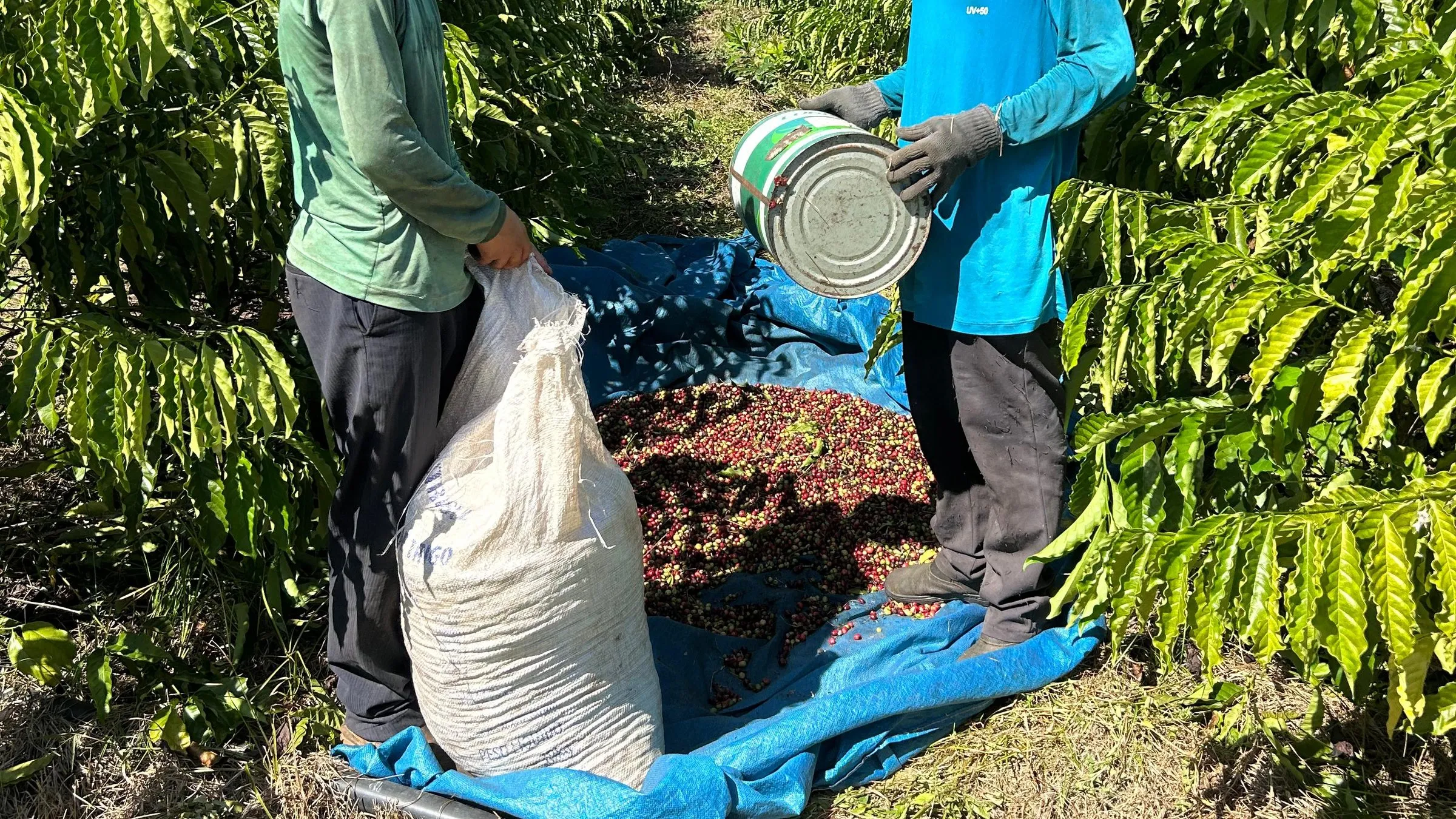
A member family harvests cherry from their own plot and delivers it to the cooperative receiving point.
What is recorded
Producer identity, property, delivery date, delivered weight and moisture at receipt.
What documentation is generated
Cooperative delivery receipt tied to the member registration.
-
Cooperative receipt and processing
What happens
Deliveries are received, dried where required, and assembled into processing batches. This is the point at which individual deliveries become a lot.
What is recorded
Which deliveries make up which batch — the link that determines how far back a finished lot can be traced. The batching rule behind each lot is shared with qualified buyers on request.
What documentation is generated
Batch composition record.
-
Mill and roast at origin
What happens
Hulling, cleaning, screening and density separation to an export specification. For the roasted line, roasting, grinding and packing follow on the same site.
What is recorded
Screen distribution, defect count, moisture, water activity and cup score per lot; roast curve and Agtron per production run.
What documentation is generated
Quality analysis sheet, cupping report, roast log, lot code assignment.
-
Export and shipping
What happens
Lots are stuffed, documented and shipped by us rather than sold on to an exporter who re-labels them.
What is recorded
Container number, seal number, stuffing date, bill of lading and the lot codes inside.
What documentation is generated
ICO certificate of origin, phytosanitary certificate, weight and quality certificates, bill of lading, packing list.
-
Buyer
What happens
The coffee arrives green or as a finished packed product. The lot code on the bag resolves back through every stage above.
What is recorded
Outturn sample results where drawn, and any claim or allowance settled against them.
What documentation is generated
Retained samples held by us for the period set out in the supply agreement, available for comparison against outturn.
What documentation ships with every lot?
Certificate of origin, phytosanitary certificate, weight and quality certificates, the quality analysis, the lot code record and, once cupping has taken place, the cupping report. Roasted shipments add destination labelling and production records.
| Document | Applies to | Issued by |
|---|---|---|
| ICO certificate of origin | Green and roasted | Brazilian coffee authority under the ICO system |
| Phytosanitary certificate | Green | Brazilian plant health authority, per shipment |
| Weight certificate | Green and roasted | Named in the supply contract |
| Quality analysis sheet | Green | Colinza QC laboratory |
| Cupping report | Green | Colinza QC laboratory, after the 2027 harvest cupping |
| Lot code and traceability record | Green and roasted | Colinza |
| Roast log and Agtron record | Roasted | Colinza |
| FDA Prior Notice confirmation | US-bound shipments | Filed before arrival |
| EUDR due diligence statement | EU-bound shipments | The EU operator placing the coffee on the market; supporting data confirmed per contract |
| Bill of lading and packing list | Green and roasted | Carrier and Colinza |
| Additional documents on request | Both | As agreed with the buyer |
How do you read a Colinza lot code?
The lot code encodes harvest year, producer group and processing date, so a bag in your warehouse resolves back to a specific batch without a phone call. The exact scheme is being finalised, and it is not kept internal.
Every buyer receives the scheme in writing, segment by segment and with a worked example, before the first order.
Sharing the scheme rather than treating it as internal is deliberate. A buyer who can decode a bag marking themselves does not need to trust us about what it means.
Are you ready for EUDR?
The EU Deforestation Regulation requires plot-level geolocation proving the coffee was not grown on land deforested after 31 December 2020, plus a due diligence statement from the operator placing it on the EU market. Our status against each requirement (plot-level geolocation, cut-off date evidence, due diligence statement support, records linking plot to lot, and third-party verification) is set out in writing for EU buyers before the first order, rather than asserted as complete here.
For European buyers this is becoming a hard gate rather than a preference, and being ahead of it is a genuine commercial advantage. Being honest about where we are is more useful to you than a claim you would have to audit anyway.
Can we use your origin content in our own marketing?
Yes, and we would rather you did. Photography, producer profiles and the origin story are offered as assets for your packaging, your website and your sales material. It costs us nothing and it is worth a great deal to a private label client.
Photography
Farm, harvest, processing and producer imagery, licensed for your use on pack and online.
Producer profiles
Named producers with real numbers and their own words, as published on our origin page.
The origin account
The region, the cooperative and the processing chain, written to be retold by your brand.
Lot-level records
The analysis and traceability record for the specific lot in your product.
Ask for the origin asset pack when you request the capabilities packet. Licensing terms for your use of the photography are confirmed in writing with the pack.
Private label and contract roasting Food safety and compliance
Request green offerings
Tell us what you roast and at what volume, and we will send the current position with a basis.
Request green offeringsRequest a private label capabilities packet
Formats, minimums, lead times and certification status, in one document.
Request the capabilities packet